Artificial Intelligence has taken the world by storm over the last few years. While its origins as an academic discipline go all the way back to 1956, the AI boom of the 2020s has witnessed unprecedented growth.
From Large Language Models (LLMs), through AI image generators, to autonomous vehicles and beyond, artificial intelligence is becoming an inescapable part of our daily lives.
And it’s not going away, as AI development continues at a tremendous pace.
To get a better understanding of the current state of the AI landscape, we decided to take a deep dive into the latest AI statistics.
Let’s crack on!
Astonishing Artificial Intelligence Statistics (Editor’s Picks)
- 1.1 billion people use AI as of early 2026.
- The global AI market is expected to be worth nearly $3.5 trillion by 2033.
- AI is projected to contribute $15.7 trillion to the global economy by 2030.
- The UK artificial intelligence sector is expected to reach £80.8bn in 2026.
- 39% of working‑age people in the UK used AI in the second half of 2025.
- 62% of global organisations are trying out AI agents.
- 67% of global marketing & sales businesses have seen revenue growth thanks to AI use.
Global AI Statistics
The advent of generative AI tools like ChatGPT, Gemini, and Midjourney in 2022 was a game changer. With lightning fast content generation, task automation, content synthesis, and much more, they have created a lot of enthusiasm as well as fears of job losses all over the world.
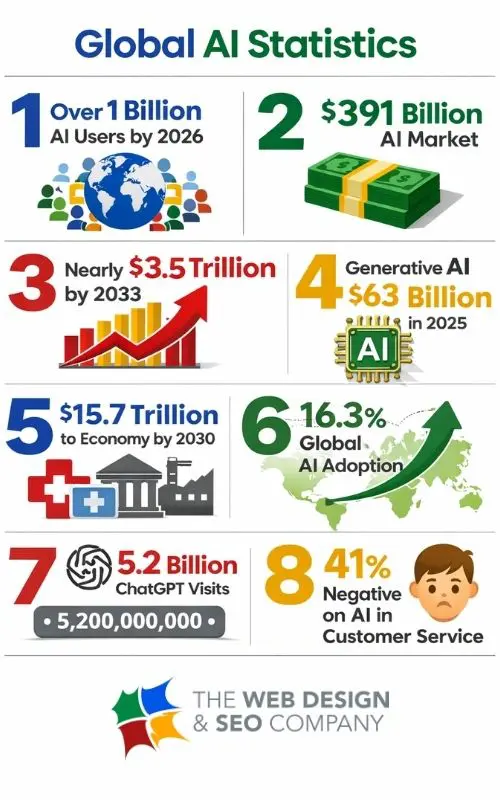
1. As of 2026, more than 1 billion people use AI.
(Source: Resourcera)
The latest AI stats suggest around 1.1 billion people worldwide use AI as of January 2026. Given that the current world population is around 8.3 billion, this means that more than one in eight people on Earth are now AI users.
The ratio becomes even more impressive when you factor in that there are ‘only’ about 6 billion active internet users.
2. The global AI market is valued at around $391 billion.
(Source: Grand View Research)
Unsurprisingly, the United States is the largest Machine Learning market in the world, as well as the region with the most investments in AI.
However, it’s only the second AI-developing nation by operating environmental score, AI environmental impact statistics show. The leader? Italy, with a perfect score of 100.
3. The global AI market size is expected to reach nearly $3.5 trillion by 2033.
(Source: Grand View Research)
This projection is based on an extraordinary Compound Annual Growth Rate (CAGR) of 30.6% between 2026 and 2033. Tech giants continue to pour money and resources into AI research, which is driving the ongoing adoption of these technologies across industries ranging from finance to education.
4. The global generative AI market was worth $63 billion in 2025.
Generative AI companies like OpenAI, Cohere, and Anthropic have been at the forefront of the AI revolution of the early 2020s. Since then, established tech giants, including Microsoft, Google, and Meta, have jumped on the bandwagon.
So, it should come as no surprise that the gen AI market is expected to continue to grow by leaps and bounds, reaching $91.57 billion in 2026 and perhaps as much as $400 billion by 2031.

5. AI is projected to contribute $15.7 trillion to the global economy by 2030.
(Source: Authority Hacker, Holistic)
This estimate represents an impressive 14% increase compared to a case without AI. The sectors expected to benefit from the highest AI-driven growth are as follows:
- Healthcare & Medicine
- Finance & Banking
- Manufacturing
- Retail & Consumer Goods
- Education
As the current global leaders in AI research & development, the United States and China are expected to be the biggest beneficiaries.
6. According to artificial intelligence statistics, global AI adoption increased from 15.1% to 16.3% in 2025.
(Source: Microsoft)
2025 saw a steady increase the adoption of AI tools worldwide. But where the rate is highest might surprise you.
Check this out: The United Arab Emirates remain at the forefront of AI adoption, with 64% of its working age population using AI at the end of 2025, compared to 59.4% at the beginning of the year. Singapore was second, with 60.9%.
7. ChatGPT had 5.2 billion total visits in December 2025.
(Source: Exploding Topics)
With well over 5 billion visits during the last month of 2025, ChatGPT was the fifth most visited site in the world, behind Google, YouTube, Facebook, and Instagram.
The average time per visit was 17 minutes and 45 seconds, showing that most users favoured longer, engaged sessions rather than quick drop ins.
8. 41% of people aged 34 and younger have negative feelings about companies using AI in customer service.
(Source: Survey Monkey)
This figure compares to 72% of people over 65; AI in customer service statistics suggest having negative feelings. As early adopters of new technologies, younger people are naturally more open to interacting with AI solutions, such as AI assistants and chatbots.
In contrast, older people still prefer to deal with humans by a long stretch. Across the board, 42% of buyers are happy with AI-driven product recommendations.
AI Statistics for the UK
The United Kingdom is a worldwide leader in the development of artificial intelligence. The UK Government adopted an AI Opportunities Action Plan in January 2025, which envisions investing in AI foundations and facilitating widespread AI adoption across different sectors of the economy.
Altogether, the aim of this bold UK AI strategy is to ensure the country is ‘an AI maker, not an AI taker’.
That’s all well and good. But what do the latest statistics about AI in the United Kingdom have to say?
Let’s find out!
9. As of 2026, the UK is the third largest AI market in the world.
(Source: Business.gov.uk, Data City)
The United Kingdom’s AI market was valued at £72.3bn in 2024, making it the largest in Europe and the third largest in the world, behind the US and China.
Thanks to private investment as well as government support, the sector is enjoying robust growth and is expected to grow to £80.8bn in 2026 and £86.7bn in 2027. This makes the UK extremely well positioned to shape emerging artificial intelligence trends over the next few years.
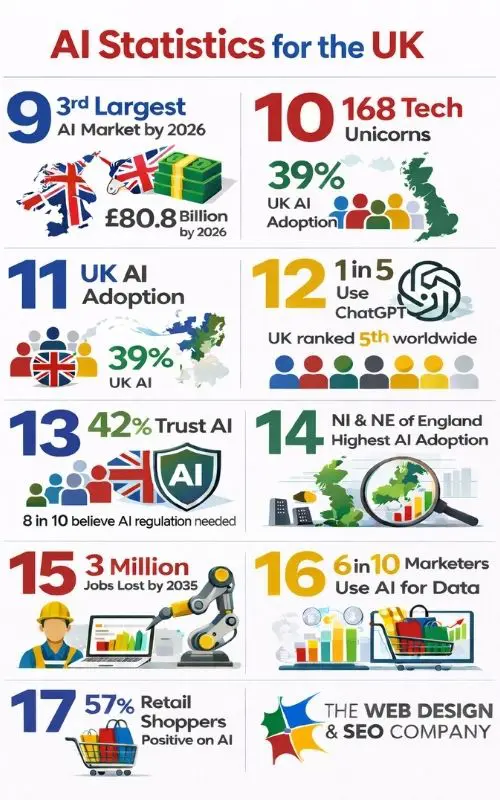
10. The UK is the first European country with 168 tech unicorns.
(Source: Business.gov.uk)
In case you were wondering, a unicorn is an unlisted private company with an estimated value of over $1 billion. In fact, 12% of UK startups with $100m–$250m in funding become unicorns. This compares favourably with the US, where the corresponding figure is 14%.
All in all, UK tech companies are now worth more than $1 trillion in total. In addition, there are more than 3,700 AI companies in the UK, and the number continues to grow.
11. 39% of working age people in the UK used AI in the second half of 2025, AI adoption statistics reveal.
(Source: Microsoft)
Nearly four in ten working-age Brits used AI tool at the end of last year. This figure was up from 35.4% during the first half of 2025.
However, the UK was ranked only ninth in the world in terms of AI adoption. At the end of 2025, the UK was lagging behind global leaders like the UAE (64%) and Singapore (61%), as well as European frontrunners like Norway (46.4%), Ireland (44.6%), and France (44%).
12. 1 in 5 active internet users in the UK use ChatGPT.
(Source: TDMP)
Given that ChatGPT is the fifth most visited website in the world, it’s no surprise that it’s extremely popular with Brits. In fact, the UK is currently ranked fifth in ChatGPT usage worldwide, behind the US, Brazil, India, and Canada.
Londoners are leading the way, with 30% using the Large Language Model (LLM) in February 2025. However, when adjusted for population size, Mancunians are the most interested in ChatGPT, whereas Invernessians are the least interested, followed by people in Newport, Derry, and York.

13. 42% of Brits say they trust AI, statistics about AI reveal.
(Source: KPMG)
Even as more and more UK residents are using AI tools, many maintain a healthy scepticism about its output. What’s more, eight in ten believe AI regulation is required.
It’s even more complicated:
Whereas 57% of Brits approve the use of AI, 72% believe online content cannot be trusted because it might be AI-generated.
14. Businesses in Northern Ireland and the North East of England have the highest AI adoption rates in the UK.
(Source: Moneypenny)
40% of companies based in Northern Ireland and 39% located in the North East of England are fully embracing AI. These are the highest AI adoption rates in the country, even ahead of Greater London, where the figure currently stands at 35%.
The East of England has the lowest rate by far, with only 15%.
15. Automation and AI might lead to the loss of around 3 million low-skilled jobs in trades and machine operations by 2035 AI in business statistics warn.
(Source: The Guardian)
One of the biggest fears about agentic AI is the loss of jobs. And it’s not unfounded, either, especially when it comes to low-skilled jobs.
In contrast, highly skilled UK professionals are expected to be in demand in the short to medium term, AI growth statistics suggest, as technological advances are likely to increase workloads.
16. Six in ten UK marketers say AI is crucial to making full use of customer data to meet business objectives.
(Source: Emarsys)
Around 60% of marketers in the UK consider AI essential for unlocking the full value of customer data as part of their marketing campaigns. They see the main advantages are turning data into meaningful insights, enabling more accurate targeting and better personalisation.
On the other hand, only 34% of buyers are in favour of businesses bringing more AI into their buying experience.
17. 57% of shoppers report a positive impact of AI on their retail experience.
(Source: Emarsys)
According to AI in retail statistics, nearly six in ten UK shoppers have benefited from AI during their purchasing journey. This figure is considerably higher than the global average, with only 33% of customers in the US and 41% of buyers in Germany reporting the same.
Key takeaway:
Clearly, British shoppers are willing to embrace AI more than their counterparts overseas.
AI Applications in Business
Small, medium, and large businesses worldwide are keeping a close eye on the latest artificial intelligence trends. But not all employers are well equipped to take advantage of the benefits of AI in business or face the challenges this disruptive technology poses in what are still relatively early days.
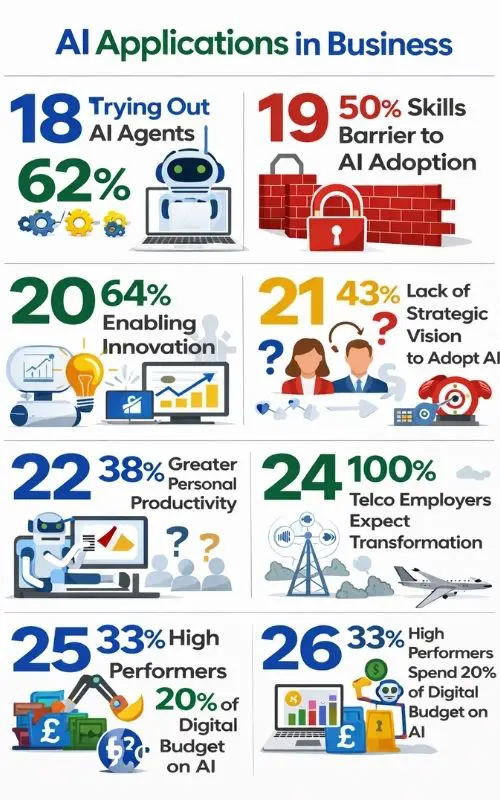
18. 62% of global organisations are trying out AI agents.
(Source: McKinsey)
Even though nearly two thirds of global companies are trialling agentic AI in their day-to-day operations, the vast majority are still in the early phase of AI adoption.
A recent survey showed that only 7% of companies had fully integrated AI into their processes in 2025.
Here’s why:
19. 50% of global businesses find the lack of skills as the main barrier to AI adoption.
(Source: Statista)
Half of global businesses cite a lack of skills as the primary barrier to adopting AI, highlighting a significant gap between ambition and capability.
Many organisations struggle to find or develop the technical expertise needed to implement, manage, and scale AI solutions effectively.
20. 64% of global businesses say that AI is enabling their innovation.
(Source: McKinsey)
By embracing AI, close to two thirds of companies worldwide have been able to develop innovative business strategies, AI usage statistics reveal.
However, only 39% saw noticeable Earnings Before Interest and Taxes, which suggests that marketers are still struggling to make the most of agentic AI.
21. 43% of businesses globally say that a lack of strategic vision among managers and leaders is the biggest barrier to adopting AI.
(Source: Statista)
Other key barriers include the high cost of AI products and services (29%), limited ability to tailor solutions to specific local business needs (24%), complex and expensive regulations governing AI and data use (21%), and relatively low consumer demand for AI-driven offerings (16%).
22. 38% of AI decision-makers report that greater use of AI for personal productivity has delivered positive outcomes for their organisation.
(Source: Forrester’s State Of AI Survey)
The most common view is that, at this point, AI mostly enhances human work rather than replacing it. Even as autonomous, agentic AI continues to advance, people remain at the core of how work is carried out and are crucial for the successful use of AI.

23. 80% of companies worldwide set efficiency as a goal of their AI efforts.
(Source: McKinsey)
According to recent artificial intelligence data, the vast majority of global companies prioritise efficiency as the primary objective of their AI initiatives, using the technology to streamline operations, reduce costs, and improve productivity.
That being said:
Organisations that make the most of AI tend to go beyond efficiency alone, pairing it with broader goals such as driving growth and unlocking previously untapped revenue streams.
24. 100% of global telecommunication employers believe AI & big data will be transformation drivers from 2025 to 2030.
(Source: Statista)
Virtually all global telecommunications employers expect AI and big data to be major drivers of transformation over the next five years. Similar sentiment is seen across information and technology services (99%) and insurance and pension management (98%).
At the other end of the spectrum, expectations are somewhat lower in more traditional sectors such as oil and gas (69%), mining and metals (66%), and energy technology and utilities (64%).
25. 73% of global automotive & aerospace employers think autonomous systems and robots will drive enterprise transformation in the next five years.
(Source: Statista)
According to recent AI data, more than seven in ten employers in the automotive and aerospace sectors believe autonomous systems and robots will be key drivers of enterprise transformation between 2025 and 2030.
Similar rates are evident in consumer goods production and retail & wholesale (71%), while confidence is notably lower in sectors such as mining and metals (48%), oil and gas (40%), and real estate (38%).
26. One third of high-performing companies worldwide spend at least 20% of their digital budgets on AI.
(Source: McKinsey)
By allotting around one fifth of their digital budgets on artificial intelligence technologies, high-performing companies are able to successfully scale their AI endeavours.
What’s more:
AI statistics show roughly three quarters of high performers are scaling AI, compared to one third of other businesses.
AI in the Workplace Statistics
Without a doubt, the biggest impact artificial intelligence has – and will continue to have – is on workplace processes and dynamics. Many people fear AI might replace them altogether, leaving them jobless.
Are those fears justified?
AI replacing jobs statistics paint a more complicated picture.
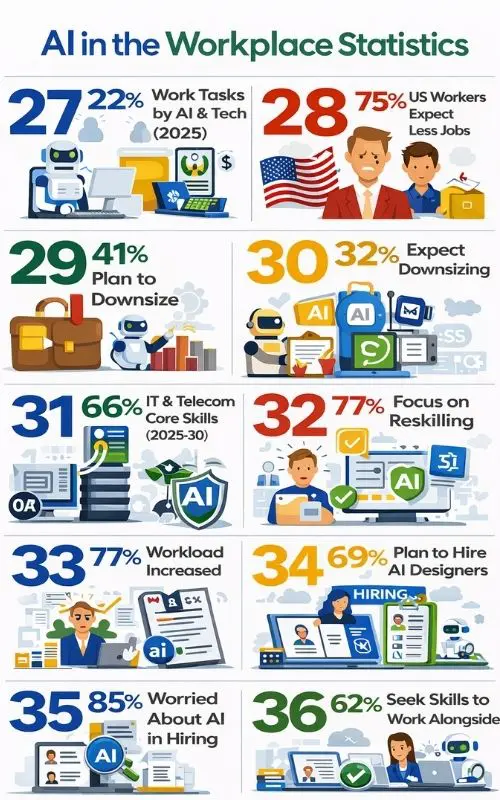
27. 22% of global work tasks were handled by machines & technology in 2025, AI statistics point out.
(Source: Statista)
AI technology managed roughly one-fifth of total work tasks worldwide in 2025. 47% were completed by humans, and 30% by a combination of the two.
By 2030, in contrast, AI technology will be responsible for 34% of all work tasks, whereas 33% will be done by people, and 33% by a combination.
28. 75% of US workers believe AI will reduce the amount of jobs in the next 10 years.
(Source: Gallup)
Three quarters of American adults think the artificial intelligence industry will replace plenty of jobs over the next decade.
And that’s not all:
77% of adults don’t trust businesses to use AI in a responsible manner.
29. 41% of global businesses plan to downsize their workforce where AI can do the work during the next five years.
(Source: Statista)
The fact that more than four in ten companies intend to replace workers with AI is one of the most concerning artificial intelligence statistics at the moment. This highlights the necessity for workers to reskill and adapt quickly to an increasingly volatile global job market.
30. 32% of employers worldwide think AI adoption will lead to downsizing their workforce.
(Source: McKinsey)
Even business owners who aren’t actively planning to lay off employees believe AI technology will make that a fact.
That being said:
43% of employers expect no change, whereas 13% think they might need to hire more people.
31. 66% of global information and technology services employers believe AI and big data will be core skills between 2025 and 2030.
(Source: Statista)
The same percentage of telecommunication employers feel the same way. This should come as no surprise, since AI plays an important role in disseminating large quantities of data. The financial services and capital markets industry is third, with 61%.
On the opposite end are oil & gas with 31%, accommodation, food & leisure with 26%, and mining & metals with 25%.
32. According to new AI statistics, 77% of businesses worldwide intend to focus on reskilling and upskilling their existing workforce to work better alongside AI.
(Source: Statista)
This reflects a global shift in how companies are preparing for an AI‑augmented future. Rather than viewing AI as simply a technology to be installed, businesses increasingly see skills development within their existing workforce as pivotal to remaining competitive, innovative, and resilient.
It might be an uphill battle, though.

33. 77% of employees reported that AI tools added to their workload.
(Source: Forbes)
Even though generative AI is supposed to help employees manage their workloads better, nearly eight in ten appear to be struggling to make the most of it.
It gets worse:
AI statistics show 71% were burnt out due to of AI, and 65% couldn’t cope with the increased productivity levels their employers demanded.
34. 69% of businesses worldwide businesses plan to hire workers with skills to design AI tools and functions for their organisation.
(Source: Statista)
More than two thirds of companies recognise the need to bring in specialised talent to build, tailor, and govern their AI systems — not just to adopt off‑the‑shelf AI tools.
This priority reflects the strategic importance of AI technical skills in shaping future business capabilities, bridging existing skill gaps, and driving innovation.
35. 85% of Americans are worried about AI making hiring recommendations.
(Source: Gallup)
With hundreds of candidates applying for competitive jobs, more and more hiring committees are relying on AI tools for recommendations.
While most workers don’t necessarily object to that, 57% firmly believe companies should be transparent about how they use AI in their business practices.
36. 62% of global businesses are looking to hire people will skills to work better alongside AI.
(Source: Statista)
More than six in ten companies worldwide intend to hire employees who have the necessary skills to make the most of artificial intelligence in the future.
Clearly, most employers envision generative AI as a helpful tool that can boost employee’s productivity levels and overall output rather than replacing them altogether.
AI Marketing Statistics

Marketers are leading the way in terms of adopting agentic AI. And its definitely paying off, with growing revenues and increased conversion rates across the board.
Here’s what AI statistics from 2025 have to say about AI in marketing.
37. 67% of global marketing & sales businesses have seen revenue growth thanks to AI use.
(Source: McKinsey)
This was the highest among all sectors. Strategy & corporate finance was second, with 65%. Among these, one in ten saw an increase of over 10%, 14% witnessed an increase of between 6% and 10%, and 43% saw an increase of less than 5%.
Revenue increases resulting from AI use are most commonly reported in marketing and sales.
38. Companies that use AI for lead targeting have seen a 30% increase in conversion rates compared to those who only use traditional methods.
(Source: SuperAGI)
Companies using AI to drive their lead targeting campaigns have seen a massive jump in conversion rates.
With that in mind, it makes sense that over 80% of companies in the US are already leveraging AI in their marketing efforts.
39. 49% of global marketing and sales companies report cost decreases thanks to AI.
(Source: McKinsey)
How did their savings compare?
Here’s the thing:
7% of marketing & sales businesses worldwide reported a substantial decrease of over 20%, 8% reported a decrease of 11%-19%, and 33% reported a decrease of less than 10%.
And on that note…

The Bottom Line
And there you have it:
Over 39 incredible AI statistics and facts about AI that define the global state of the field in 2026.
As the AI industry continues to evolve at a tremendous pace, many AI companies are targeting fully autonomous AI agents that can perform multiple tasks without human intervention in the not too distant future.
At the Web Design and SEO Company, we will continue to closely monitor the latest AI trends and developments, so we can help UK businesses to make the most of this innovative technology in their respective industries.
Stay tuned!
Frequently Asked Questions
How many people use AI?
More than 1 billion people use artificial intelligence, AI statistics for 2026 suggest. Specifically, around 1.1 billion people worldwide are AI users. This means roughly 1 in 8 people on Earth and about 1 in 6 active internet users use AI.
How many people in the UK use AI?
Roughly 39% of working‑age people in the UK used AI in the second half of 2025. This means that approximately 16.5 million Brits use AI.
Which country is no. 1 in AI?
The country that is number one in AI overall is the United States – it consistently leads global rankings in artificial intelligence based on investment, research & development, startup activity, and ecosystem vibrancy.
China is ranked second globally, with massive scaling of AI infrastructure, deployment, and real-world applications. The UK is ranked third in many rankings, and it’s especially strong in research and policy.

What is the 10 – 20 – 70 rule for AI?
The 10-20-70 rule for AI is a practical guideline used in AI adoption and digital transformation to show where time, effort, and investment really go when implementing AI successfully.
When organisations introduce AI:
- 10% → Technology
- The AI models, algorithms, and tools themselves
- Software, platforms, data science, automation
- 20% → Data & Process
- Data quality, integration, governance
- Redesigning workflows so AI can actually be used
- 70% → People & Change
- Training employees to use AI
- Changing mindsets, culture, and ways of working
- Leadership, trust, ethics, and adoption
- Overcoming resistance and fear of job loss
Is AI correct 100% of the time?
No – AI is not correct 100% of the time. Even the most advanced AI systems can make mistakes.
The thing is:
AI models are trained on large datasets. If the data is incomplete, biased, outdated, or simply incorrect, the AI can produce wrong or misleading answers.
Most AI systems (especially generative AI tolls like ChatGPT, Gemini, and Claude) work by predicting the most likely answer, not by understanding facts the way humans do. This can lead to confident-sounding but incorrect answers or ‘hallucinations’ (made-up information).
How does AI predict trends?
AI predicts trends by analysing large amounts of data, finding patterns, and projecting those patterns forward. It doesn’t ‘see the future’ – instead, it uses probability and AI statistics to make informed predictions. AI looks at historical and real-time data. More data equals better pattern detection.

Get in Touch
If you’re looking to get your business found on AI search, the Web Design and SEO Company are here to help. Book a Call with us today, and let’s start your journey towards real growth.